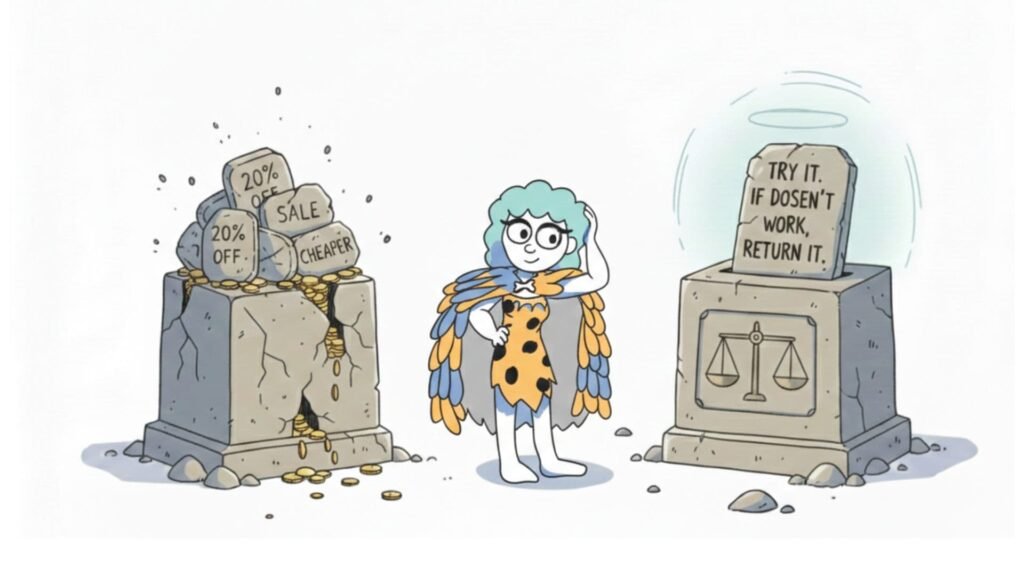
High Hold Rate but low purchase rate? You’re building trust but not removing enough risk. Here’s how to fix it.

Agenda:
- The 5 Types of Authority in Order of Impact
- Deployment Strategy Across Customer Journey Stages
- Identifying Missing Authority Types
- Seven Authority Positioning Failures to Avoid
- The Authority Layering Framework
- Building Authority From Zero
- Authority Maintenance Requirements
- Converting Analytical Buyers Through Strategic Authority
Most brands struggle with the same problem: high traffic, strong engagement, but disappointing conversion rates. Visitors read product pages, scroll through testimonials, browse case studies—then leave without buying.
The issue isn’t the product. It’s authority positioning.
Research shows that 81% of consumers need to trust a brand before making a purchase decision. For analytical, risk-averse buyers who spend weeks researching options, that trust threshold is even higher.
Yet most brands rely on a single authority type—credentials and certifications—which happens to be the weakest form of proof for high-consideration purchases.
This article breaks down the five types of authority that drive conversion for analytical buyers, how to deploy each type at specific stages of the customer journey, and why the standard “show your credentials” advice fails for brands selling high-ticket or high-consideration products.
Why Standard Authority Strategies Fail for Analytical Buyers
The conventional advice sounds simple: position the brand as an expert. Add credentials to the About page. Display certifications. Create an “As Seen In” section with publication logos.
These tactics establish baseline credibility, but they don’t close sales with analytical buyers who’ve been disappointed by previous purchases.
These buyers aren’t questioning whether a brand has qualifications. They’re questioning whether the solution will actually work after three other options already failed them.
That doubt requires a different type of authority entirely.
The 5 Types of Authority in Order of Impact
Authority isn’t monolithic. Different types of authority answer different buyer questions, work at different stages of the customer journey, and carry different weights in the purchase decision.
Here’s the hierarchy from weakest to strongest:
Type 1: Credential-Based Authority
Credential-based authority includes degrees, certifications, professional accreditations, and industry awards.
What it communicates: The business is qualified to provide this service or product.
Why it’s the weakest: Every competitor has credentials. The brand that disappointed the buyer last month had credentials too. Certifications prove someone passed exams, not that they can solve specific problems.
When it works: Stage 3 of the customer journey, when buyers are vetting multiple options and need baseline proof of legitimacy. Credentials alone won’t close the sale.
Optimal placement: About page, team bios, footer sections.
Example: “Certified Financial Planner with CFP designation” or “Board-certified dermatologist.”
The limitation is clear: these statements are generic. They demonstrate qualification but not differentiation.
Type 2: Association-Based Authority
Association-based authority is borrowed credibility through media mentions, brand partnerships, client logos, and industry affiliations.
What it communicates: Respected organisations trust this brand.
Why it’s more powerful: It transfers trust from established names to newer brands. Nielsen research indicates 70% of consumers trust expert endorsements.
When it works: Stage 3 of the customer journey, particularly effective for newer brands that lack extensive track records.
Optimal placement: Homepage hero section, press pages, case study introductions.
Example: “Featured in Forbes, used by Google and Microsoft” or “Official Shopify partner.”
For small brands without years of client results, this is the starting point. Guest blogging on respected publications, securing media quotes, and partnering with established brands all extend their authority to newer market entrants.
Type 3: Process-Based Authority
Process-based authority explains a brand’s unique methodology or proprietary system.
What it communicates: This brand understands why previous solutions failed and has developed a different approach.
Why analytical buyers respond: They’ve experienced failures. They need to understand the mechanism behind solutions. Generic promises trigger scepticism—they need the “why” behind the approach.
When it works: Stage 2 (Problem Aware) and Stage 3 (Solution Aware), when buyers are diagnosing their problem and evaluating different methodologies.
Optimal placement: Product pages, explainer videos, methodology documentation.
Example: Instead of “We help businesses grow,” use “We employ a three-phase diagnostic system: identify which of four buyer archetypes the target customer represents, map their five-stage psychological journey, then deploy stage-specific influence methods.”
The difference is specificity. The second version demonstrates understanding that buyers don’t possess yet. It reveals a framework they haven’t considered.
This is the most underutilised authority type. Most brands claim expertise without explaining their proprietary process.
Type 4: Experience-Based Authority
Experience-based authority showcases track record through years in business, number of clients served, and specific challenges solved repeatedly.
What it communicates: This brand has successfully navigated this exact problem multiple times.
Why it matters: Analytical buyers want proof the brand has handled their specific situation before, not just similar challenges.
When it works: Stage 4 (Product Aware), when buyers are comparing options and need proof this is the safer choice.
Optimal placement: Case study pages, testimonial sections, client results galleries.
Example: “Worked with 247 D2C brands to scale profitably without discounting” beats “10 years of marketing experience.”
Specificity drives impact. Research shows “specialists in tax planning for small businesses” converts better than “experienced accountants” because it demonstrates precise relevance.
Type 5: Results-Based Authority
Results-based authority presents measurable outcomes from real client engagements.
What it communicates: This solution produces verifiable results.
Why it’s strongest: It eliminates doubt. The brand isn’t claiming expertise—it’s demonstrating it with data.
When it works: Stage 4 (Product Aware) and Stage 5 (Most Aware), when buyers believe the solution could work in theory but need proof it works in practice.
Optimal placement: Landing pages, adjacent to call-to-action buttons, checkout pages.
Example: “Flex and Iris eyeglasses tested messaging combining their 3-step process with visual examples and risk-free shopping. Result: 75% conversion increase.”
What makes this compelling: specific methodology, specific outcome, measurable metric. Not “clients see great results”—that’s meaningless. “75% conversion increase” is quantifiable proof.
Deployment Strategy Across Customer Journey Stages
The authority type that drives conversion at Stage 3 will fail at Stage 1. Strategic deployment requires matching authority types to specific journey stages.
Stage 1: Unaware
Don’t lead with authority signals. Buyers don’t care about credentials yet because they don’t recognise they have a problem.
Stage 2: Problem Aware
Deploy Process-Based Authority. Buyers are diagnosing what’s wrong. Demonstrate understanding of the mechanism behind their struggle.
Example: “The reason previous solutions failed isn’t because of wrong choices. It’s because those solutions were designed for impulse buyers, not analytical researchers.”
Stage 3: Solution Aware
Layer Credential Authority plus Association Authority. Buyers are vetting options and need baseline proof of legitimacy and credibility.
Example: Professional credentials in team bios, client logos, media mentions combined.
Stage 4: Product Aware
Switch to Experience Authority plus Results Authority. Buyers are comparing alternatives and need proof of track record with similar customers.
Example: “Worked with 50+ brands in this category. Here are three case studies from companies with comparable challenges.”
Stage 5: Most Aware
Results Authority exclusively. Buyers are ready to purchase but fear making the wrong choice. Remove final doubt with quantified proof.
Example: “Clients following this framework see an average 40% conversion lift within 60 days. No improvement means full refund.”
Identifying Missing Authority Types
Website analytics reveal exactly where authority positioning fails.
High bounce rate signals missing Credential or Association Authority.
Interpretation: Visitors question legitimacy immediately upon landing. They need baseline credibility signals.
Solution: Add client logos, media mentions, or professional credentials above the fold.
High scroll depth with low purchase rate signals missing Results Authority.
Interpretation: Visitors believe the solution could work theoretically but aren’t convinced it will work for them specifically.
Solution: Add detailed case studies with measurable outcomes showing before state, intervention, and after state with numbers.
High click-through rate from ads with low landing page time signals Credential Authority without Process Authority.
Interpretation: Visitors clicked because of claimed expertise but left because the unique methodology wasn’t explained.
Solution: Add methodology section explaining the “why” behind the solution approach.
High blog engagement with low conversion signals missing Experience Authority.
Interpretation: Visitors trust the brand knows information but don’t trust the brand has implemented solutions.
Solution: Add client work examples, case studies, specific metrics from past projects.
Seven Authority Positioning Failures to Avoid
Authority strategies can backfire when misapplied. Here are common failure modes:
1. Over-Signalling Creates Cognitive Overload
Listing every credential, client, award, and certification on a single page creates confusion rather than confidence.
Research demonstrates this causes cognitive overload. Attempting to communicate everything results in communicating nothing meaningful.
Analytical buyers react with suspicion: excessive persuasion attempts suggest hidden problems.
Solution: Select one or two authority signals per page. Make them specific and directly relevant to the immediate decision.
2. Generic Authority Statements Lack Impact
Phrases like “experienced professionals,” “industry-leading experts,” and “trusted by thousands” are invisible because every brand uses identical language.
Solution: Be specific. Replace “10 years of experience” with “127 high-ticket ecommerce brands scaled profitably.” Replace “industry expert” with “Former VP of Growth at Shopify, now consulting.”
3. Authority Without Behavioural Alignment
Claiming expertise whilst contradicting that positioning through actions destroys credibility.
Example: Positioning as premium expert whilst running constant 50% discount promotions. Claiming thought leadership whilst never engaging with audience questions.
Analytical buyers notice these inconsistencies immediately.
Solution: Align actions with positioning. Expert positioning requires expert behaviour.
4. Authority Extension Beyond Credibility Domain
In 1982, Colgate launched frozen dinners. The product failed completely.
Why? Consumers trusted Colgate for toothpaste. All authority around dental health and whitening technology had zero relevance to food products.
Solution: Claim authority only in domains where credibility has been established. Avoid excessive extension from core competency.
5. Claims Without Supporting Evidence
Stating “We’re the best in the industry” without proof triggers scepticism.
Authority isn’t established through language alone. It’s demonstrated through specificity and evidence.
Solution: Replace every claim with supporting data. Not “we’re experts” but “here’s our proprietary diagnostic framework and the 200 brands who’ve implemented it.”
6. Unnecessary Complexity in Technical Domains
Technical industries often showcase sophisticated capabilities through jargon and complex explanations.
Analytical buyers seek understanding, not confusion. They want clarity about solutions, not training to become experts themselves.
Solution: Explain processes in accessible terms. Authority isn’t demonstrated by sounding intelligent—it’s demonstrated by making complexity feel manageable.
7. Mismatched Authority Type and Brand Maturity
New brands claiming Results Authority they haven’t earned yet. Established brands still relying solely on Credential Authority.
Solution: Match authority type to brand stage:
- New brands: Begin with Association Authority through partnerships and media features
- Growing brands: Develop Process Authority by documenting proprietary methodologies
- Established brands: Lead with Results Authority from accumulated track record
The Authority Layering Framework
Effective authority positioning doesn’t rely on a single type. It layers multiple authority types strategically.
Sequence matters significantly.
Begin with Association Authority to establish baseline credibility. Add Process Authority to differentiate the approach. Support with Experience Authority to prove prior success. Close with Results Authority to eliminate remaining doubt.
Example sequence:
“Featured in Forbes and partnered with Shopify” — Association
“Our framework identifies which of four buyer archetypes represents the target customer, then maps their five-stage journey” — Process
“Worked with 200+ D2C brands over six years” — Experience
“Clients achieve an average 40% conversion lift within 60 days” — Results
Each layer answers a distinct question:
- Is this legitimate? — Association
- Does this brand understand the problem? — Process
- Has this been done successfully before? — Experience
- Will it actually produce results? — Results
Building Authority From Zero
For new brands without credentials, case studies, or media mentions, here’s the development path:
Months 1-3: Focus on Association Authority
- Contribute guest articles to established industry publications
- Secure media quotes as expert sources
- Establish partnerships with complementary brands
- Present at industry events or appear on podcasts
- Join professional organisations
This borrows credibility from respected names whilst building proprietary authority.
Months 4-6: Document Process Authority
- Publish detailed methodology content
- Create proprietary frameworks and models
- Explain mechanisms behind the approach
- Produce behind-the-scenes process documentation
This differentiates the brand even without extensive track record.
Months 7-12: Build Experience Authority
- Document every client engagement
- Track specific outcomes systematically
- Develop case studies with before/after documentation
- Collect detailed testimonials including metrics
This proves successful navigation of the problem repeatedly.
Year 2 and Beyond: Lead With Results Authority
- Aggregate outcome data across all clients
- Report measurable results consistently
- Compare results to industry benchmarks
- Feature specific numbers prominently in marketing
This represents transition from borrowed authority to earned authority.
Authority Maintenance Requirements
Building authority isn’t a one-time project. Authority degrades over time without maintenance.
Credentials become outdated. Case studies age. Media mentions get buried in search results.
Research shows companies strategically positioned as industry experts enjoy 20-30% higher conversion rates and command premium pricing. Maintaining that position requires consistent proof generation.
Maintenance schedule:
Quarterly: Update case studies with recent results Bi-annually: Refresh credentials and certifications Annually: Audit all authority signals for continued relevance
Continuously: Document new client successes, collect testimonials, track measurable outcomes.
Converting Analytical Buyers Through Strategic Authority
Authority positioning isn’t about claiming expertise. It’s about proving competence at the precise moment analytical buyers need specific types of proof.
Most brands default to Credential Authority because it’s simplest. They list qualifications and assume it matters.
But analytical, high-consideration buyers don’t care about exam results. They care whether the solution will work when previous options failed.
That requires Process Authority at Stage 2 to demonstrate understanding of mechanisms. Experience Authority at Stage 4 to prove prior success. Results Authority at Stage 5 to eliminate remaining doubt.
The authority type that establishes credibility at Stage 3 won’t drive purchase decisions at Stage 5. The proof that demonstrates legitimacy won’t convince buyers to commit.
Match authority types to customer journey stages. Use diagnostic signals to identify missing types. Layer them strategically rather than relying on credentials alone.
And critically: authority without supporting behaviour is noise. Claiming expertise requires demonstrating it consistently.